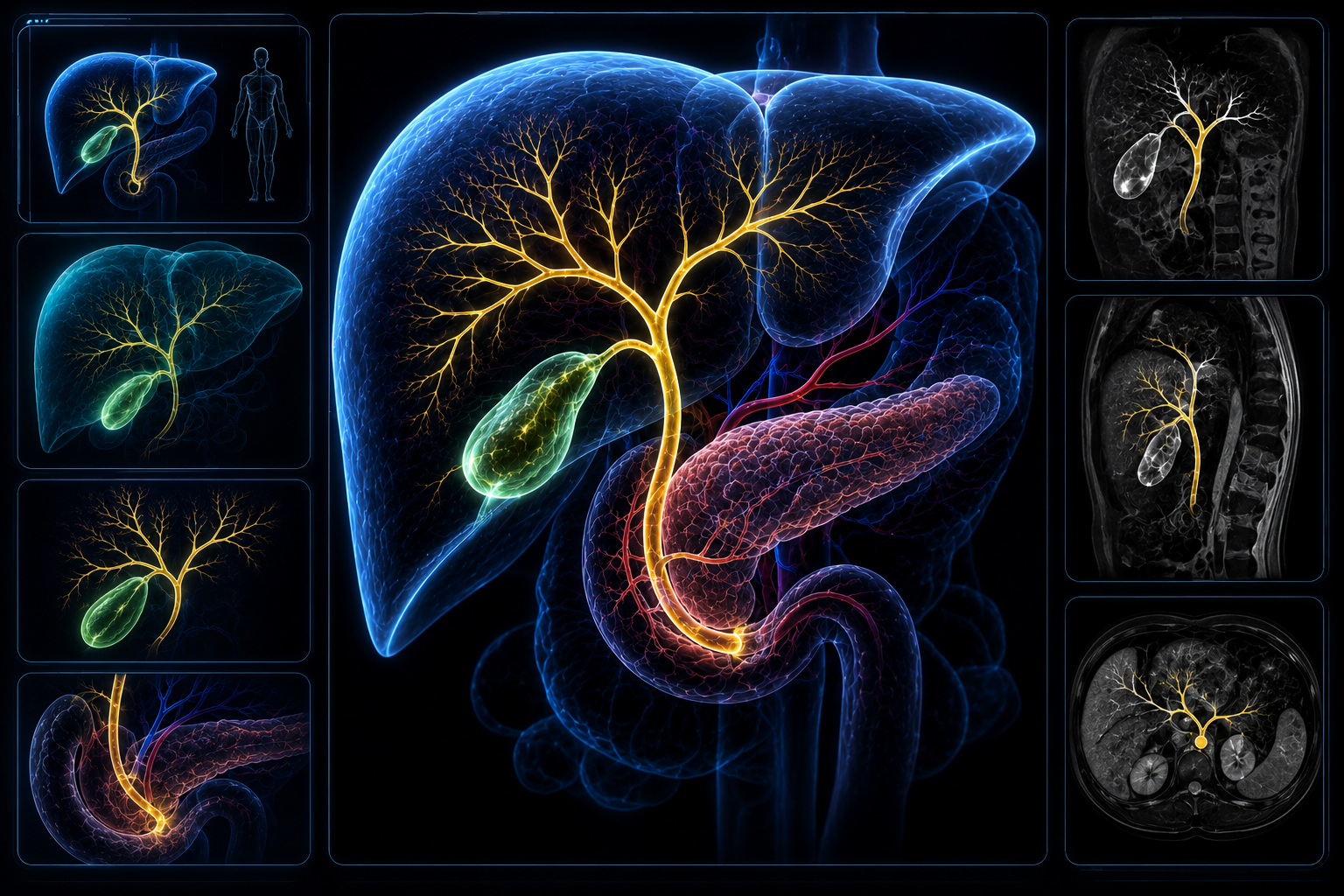
Biliary drainage complexities will not cease in 2026, and with reimbursement and resources tightening because of final rules and economic turmoil, now is a critical time to review coding for an accurate understanding. Learning when to report biliary drainage, biopsy, cholangiography, catheter conversions, and stent placement requires careful review of procedural documentation and CPT® code definitions. In this month’s case analysis, we examine a percutaneous transhepatic cholangiogram with forceps biopsy and internal-external biliary drainage catheter placement, highlighting the coding rationale behind the reported services. To further reinforce these concepts, we’ve included a series of common questions and answers that our subject matter experts have seen across the nation, addressing key biliary drainage coding scenarios and terminology frequently encountered by radiology coders.
Complex Case Analysis
CASE: CHOLANGIOGRAM, BIOPSY, AND BILIARY DRAINAGE
Procedures:
- Sonographically- and fluoroscopically-guided percutaneous transhepatic cholangiogram
- Forceps biopsy common bile duct
- Placement of percutaneous internal/external biliary drain
- Completion cholangiogram
Indication: History of biliary obstruction. Percutaneous transhepatic cholangiogram with biopsy and drainage requested.
Technique: Expected benefits, potential risks, and alternatives to the procedure were discussed with the patient and all questions were answered. Discussed risks include, but are not limited to, the following: bleeding, infection, hepatic injury, bile leak, nondiagnostic specimen, pneumothorax, contrast-induced nephropathy, idiosyncratic contrast reaction, and medication reaction. Informed consent was obtained. The patient was placed on the procedure table, the upper abdomen was prepared in the usual sterile fashion, and the ensuing procedure was performed with full barrier precaution, including caps, masks, gowns, gloves, and drapes. Procedure verification was completed. Anesthesia was administered by the department of anesthesia, who also monitored the patient throughout the procedure. A preprocedure image of the abdomen was obtained. Using a combination of sonographic and fluoroscopic guidance, needle access was gained to the biliary tree. Position was confirmed by bilious return, as well as injection of contrast. The needle was exchanged for a transition dilator over an 018 guidewire. The transition dilator was removed over an 035 guidewire, the tract was serially dilated, and a 7 French sheath was placed. Biopsy was performed. The sheath was removed and a locking loop catheter was inserted over the guidewire. The loop was formed/locked and contrast was again injected to document final position. The catheter was secured to the skin, sterilely dressed, and connected to bag drainage. The patient tolerated the procedure well.
Access: Upper abdomen (percutaneous)
Findings:
- Successful percutaneous transhepatic cholangiogram, biopsy, and biliary drainage
- Significant intrahepatic biliary ductal dilatation
- Long-segment high-grade stricture common bile duct
- Percutaneous biliary drainage catheter with distal loop in small bowel
CODE ASSIGNMENTS AND RATIONALE
47534 Placement of biliary drainage catheter, percutaneous, including diagnostic cholangiography when performed, imaging guidance (e.g., ultrasound and/or fluoroscopy), and all associated radiological supervision and interpretation; internal-external
+47543 Endoluminal biopsy(ies) of biliary tree, percutaneous, any method(s) (e.g., brush, forceps, and/or needle), including imaging guidance (e.g., fluoroscopy), and all associated radiological supervision and interpretation, single or multiple (List separately in addition to code for primary procedure)
The “findings” section of this report tells us that the catheter ended in the small bowel, and the body of the report notes that the other end was outside the body (sutured to the skin). This procedure was performed through a new access; therefore, code 47534 is reported for placement of an internal-external biliary drainage catheter. This code includes the access, contrast injections, imaging, and supervision and interpretation. It does not, however, include the biopsy performed, so add-on code 47543 is separately reported.
Although a percutaneous transhepatic cholangiogram (i.e., PTC or PTHC) was performed, contrast injection is only documented to confirm needle and catheter position. However, even if the doctor had performed a diagnostic cholangiogram, it is included in code 47534 and would not have been separately coded.
Questions and Answers in Action
What is an external biliary drainage catheter?
An external biliary drainage catheter is a catheter placed into a bile duct that does not terminate in bowel and drains bile externally only. This is defined by code 47533. This code is unilateral in nature and may be submitted for each separate drainage catheter placed.
What is an internal-external biliary drainage catheter?
An internal-external biliary drainage catheter is a single, externally accessible catheter that terminates in the small intestine and may drain bile into the small intestine and/or externally. This is defined by code 47534. This code is unilateral in nature and may be submitted for each separate drainage catheter placed.
What happens when a physician converts an external drainage catheter to an internal-external drainage catheter? Is this an exchange? Is there a code that describes this?
No, this is not an exchange but a conversion. This is defined by CPT code 47535. This code, like all percutaneous biliary interventional codes, includes contrast injection(s) whether performed or not. As such, do not submit code 47531 or 47532. This code may be submitted per catheter that is converted. The only time this code will be used is when a single external catheter is swapped out for an internal-external catheter.
What is meant by a stent for biliary procedures?
A “stent,” as used in the biliary code set, is a percutaneously placed device (e.g., self-expanding metallic mesh stent or plastic tube) that is positioned within the biliary tree and is completely internal, with no portion extending outside the patient.
⚠️Your IR Coding Remains Under Threat, Creating Significant Risk to Your Bottom Line. These Are NOT All the Tips and Tricks Necessary for Success.⚠️
With every dollar of reimbursement counting more than ever in the face of payment decline and complex changes, it’s imperative to make sure your CPT® coding is correct and compliant. Master more coding topics and break down the complexity with our 2026 IR Masterclass: GI/Biliary Interventional Radiology Coding webcast on June 10, 2026 at 11:00 am CT (120 minutes). This webcast is an essential training tool for both audio and visual learners.